

Harness, the DevOps automation platform founded by Jyoti Bansal, just raised a $240M Series E at a $5.5B valuation — a 49% jump from its 2022 round. Goldman Sachs led the $200M primary investment, with IVP, Menlo Ventures, and Unusual Ventures participating in a planned $40M tender offer.
The company claims it's on track to exceed $250M ARR in 2025 and has crossed 1,000 enterprise customers including United Airlines, Morningstar, and National Australia Bank.
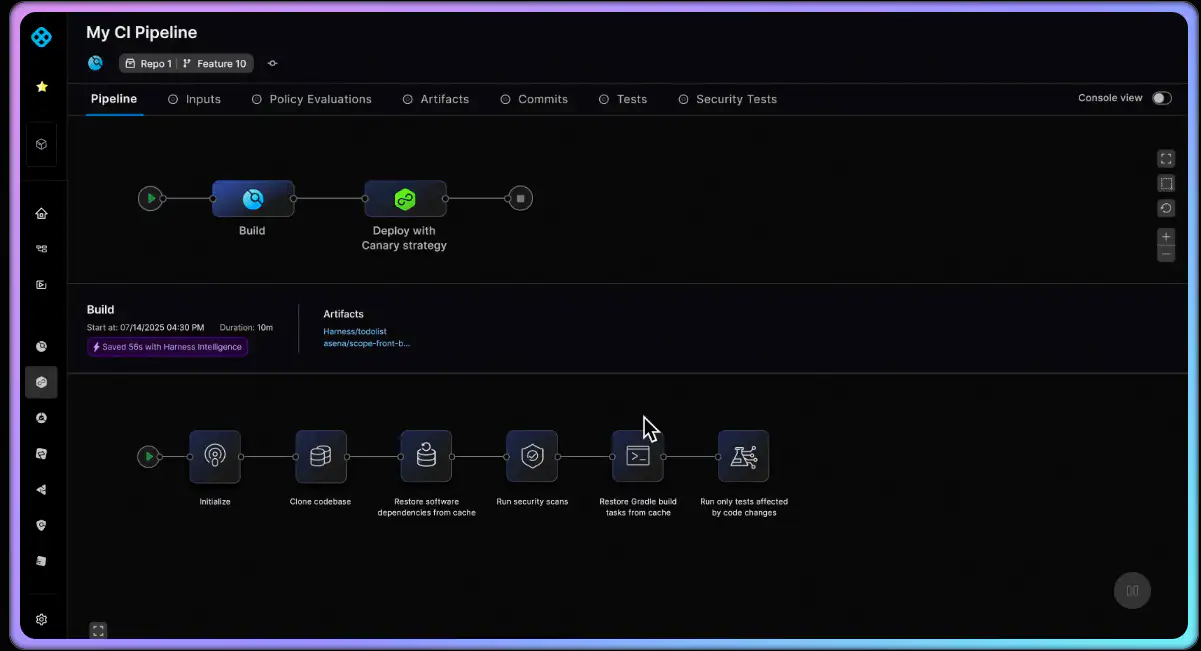
The "after-code" positioning is exactly right. Bansal is making a bet that most people are missing: AI isn't eliminating developer work, it's shifting where the bottleneck lives. If AI tools are now generating code 10x faster, the testing, security, deployment, and governance phases become the new constraint. Harness is positioning itself as the solution to a problem that's getting worse, not better, as AI adoption accelerates.
This is the kind of counter-narrative positioning that creates durable enterprise value. While everyone else is building AI code generation tools, Harness is saying "great, now you need us even more." That's a strong GTM thesis.
The knowledge graph moat is real. Harness isn't just throwing AI at the problem — they've built a software delivery knowledge graph that maps code changes, services, deployments, tests, environments, incidents, policies, and costs. This is the kind of deep technical infrastructure that compounds over time. Every deployment, every incident, every policy decision makes the system smarter and harder to rip out.
Enterprise buyers understand this. When your AI agents have context about your specific architecture and policies, that's not a feature — that's lock-in. The good kind.
The metrics are enterprise-grade. 128 million deployments handled. 81 million builds. 1.2 trillion API calls protected. $1.9 billion in cloud spending optimized. These aren't vanity metrics — they're the kind of numbers that make enterprise procurement teams comfortable. Harness has clearly earned the right to play at this valuation level through actual usage, not just ARR.
The Traceable merger signals strategic clarity. Earlier this year, Bansal merged his software observability company Traceable into Harness. The thesis — that DevOps and application security are converging — is sound and appears to be paying off. Platform consolidation plays well with enterprise buyers who are drowning in point solutions. One vendor for the entire "after-code" lifecycle is a compelling pitch.
The tender offer shows employee-friendly thinking. Including a $40M tender offer for long-term employees is a smart move. After three years since their last raise, providing liquidity keeps talent motivated and reduces the pressure to rush toward an exit. It's the kind of detail that signals mature company-building.
Goldman Sachs as lead investor. Having a major financial institution lead your growth round isn't flashy, but it's meaningful. Goldman brings credibility with the Fortune 500 buyers Harness is targeting and signals the company is being evaluated on fundamentals, not hype.
The valuation multiple demands perfection. At $5.5B on ~$250M ARR, Harness is trading at roughly 22x revenue. That's not outrageous for a high-growth DevOps platform, but it leaves very little room for execution stumbles. The company needs to demonstrate continued acceleration to justify this price — especially in a market where growth-stage valuations have compressed significantly since 2022.
The competitive landscape is brutal. Microsoft's GitHub, GitLab, Jenkins, and CloudBees aren't going away. GitHub in particular has massive distribution advantages and is aggressively building out its own AI-powered DevOps capabilities. Harness's knowledge graph is a differentiator, but Microsoft has a habit of absorbing competitive advantages into its platform over time.
The "AI agents" positioning is getting crowded. Every enterprise software company is now talking about AI agents. Harness's agents may be genuinely differentiated, but the messaging is starting to blend into the noise. The company will need to work harder to articulate why their approach is meaningfully different from what GitHub Copilot, GitLab Duo, and others are building.
India engineering concentration has risks. With 33% of the workforce in India and Bengaluru serving as their largest development center outside the U.S., Harness has significant geographic concentration. This isn't unusual for enterprise software companies, but it does create operational risk — particularly as competition for top engineering talent in Bengaluru intensifies.
This raise reflects a broader shift in where enterprise AI value is being captured. The first wave of AI hype went to code generation — Copilots and coding assistants that help developers write code faster. But enterprises are now realizing that faster code creation without faster code delivery just creates a bigger pile of untested, undeployed software.
We're seeing this pattern across DevOps: the companies that can automate the unglamorous "last mile" of software delivery — the compliance checks, the security scans, the deployment pipelines — are becoming critical infrastructure. It's not as exciting as watching AI write code, but it's where the actual enterprise pain lives.
Bansal is making the same bet he made with AppDynamics (sold to Cisco for $3.7B in 2017): that infrastructure adjacent to the code is more valuable than the code itself. That thesis paid off once. The market is betting it'll pay off again.
Harness is positioning itself as essential infrastructure for the AI-accelerated development era. The thesis is sound, the metrics are real, and the timing is right. But at a $5.5B valuation, the company has priced in near-perfect execution against formidable competitors.
If you're an enterprise buyer evaluating DevOps platforms, Harness just gave you a strong signal that they're playing for the long term. If you're a competitor, this raise means Harness is about to get significantly more aggressive in R&D and go-to-market.
The "after-code" gap is real. The question is whether Harness can own it before GitHub does.
What's your read on the DevOps consolidation play? Is one platform for the entire software delivery lifecycle the future, or will best-of-breed point solutions win?



.svg)


