

The Nikhil Kamath x Elon Musk episode isn't going viral because of any single quote.
It's going viral because for 90 minutes, Musk didn't answer questions. He replaced them.
Kamath asks about money. Musk reframes it as "a labour allocation database."
Kamath asks about spirituality. Musk pivots to "predictive value."
Kamath asks about work. Musk declares it "optional within 20 years."
Every question that lands in Musk's orbit gets absorbed into his frame. He doesn't play defence. He doesn't explain. He installs a new lens—and suddenly you're seeing the world through it.
This is narrative intelligence. And it's the skill that separates founders who get acquired from founders who get forgotten.
The 4 Beliefs That Generate Everything
Musk doesn't have opinions. He has an operating system.
Ask him about Mars, population decline, AI safety, or Twitter moderation—and every answer traces back to the same four beliefs:
1. Expand consciousness.
"By expanding the scope and scale of consciousness, we can better understand what questions to ask about the answer that is the universe."
This one belief justifies SpaceX, his population advocacy, X as a "global town square," and xAI. One belief. Four companies. Total coherence.
2. Follow physics.
"I tend to be physics-pulled. If something has predictive value, I pay attention."
He's not left. He's not right. He's "physics-pulled." This single phrase deflects every accusation of political motivation.
3. Make more than you take.
His definition of a good life. It reframes wealth as contribution—and makes wealth-criticism sound like contribution-criticism.
4. Truth is structural.
"You can make an AI go insane if you force it to believe things that aren't true."
For Musk, honesty isn't moral. It's engineering. Lies create system failures. This makes ethics feel practical, not preachy.
The Frame Game
Watch how Musk handles Kamath's questions:
Kamath Asks AboutMusk Reframes AsMoney"A database for labour allocation"Spirituality"Things with predictive value"Twitter purchase"Completing a 25-year-old vision"DOGE"A side quest"Work"Optional in 20 years"Nations"Anachronistic"His kids"Trying to get an entire Roman legion"
He never fights on the interviewer's terms. He replaces the terms entirely.
This is the difference between founders who explain and founders who define.
The Contrarian Portfolio
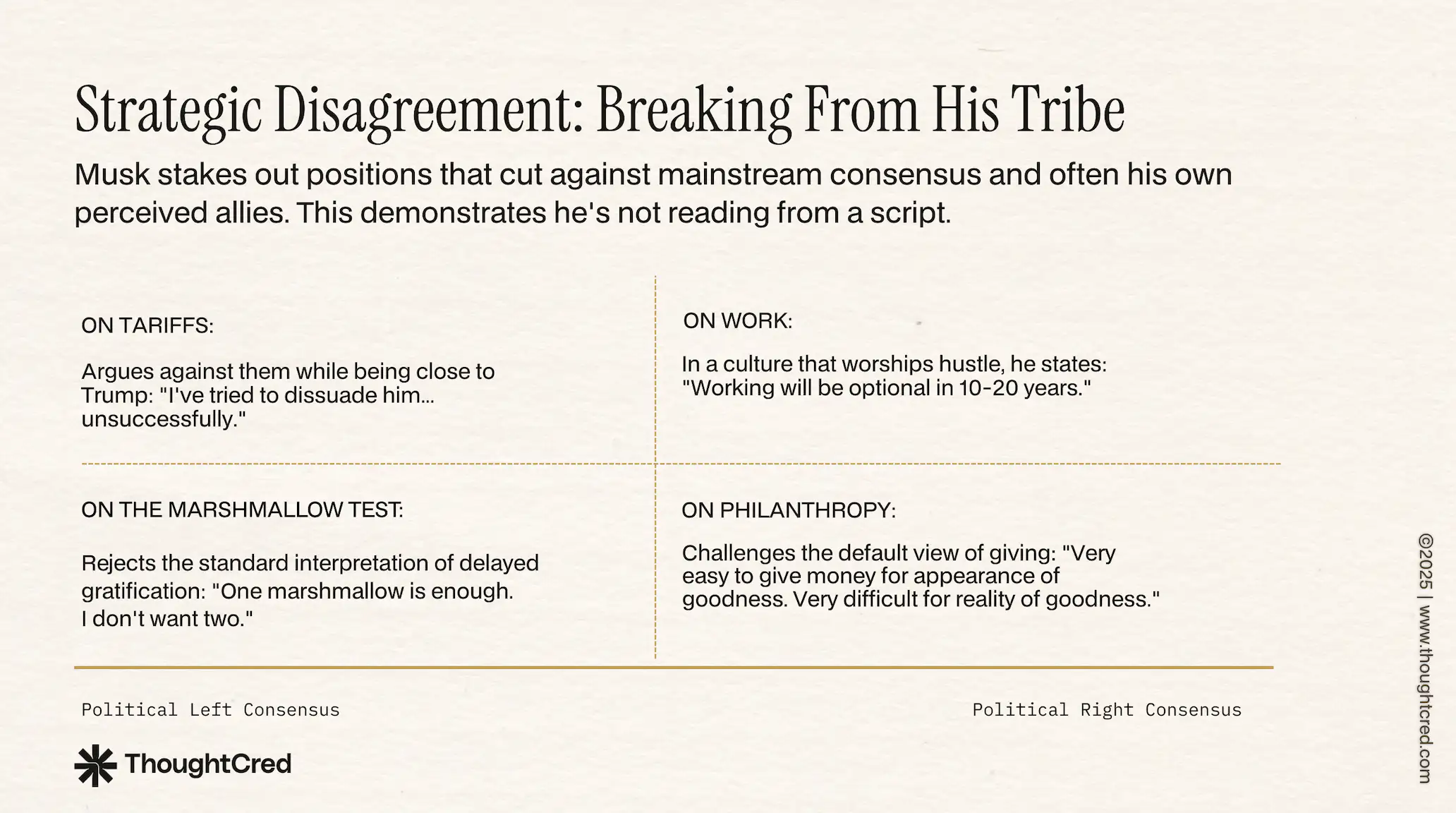
Musk holds positions that break from both tribes:
- Pro-immigration, anti-open-borders
- Pro-Trump, anti-tariffs
- Pro-philanthropy in theory, skeptical in practice
- Pro-AI, worried about AI
Each contrarian take signals the same thing: "I think for myself."
When he publicly disagrees with Trump on tariffs—while being close to the administration—he's not being reckless. He's maintaining intellectual independence while being adjacent to power.
Neither left nor right can fully claim him. That's not an accident.
Language as Territory
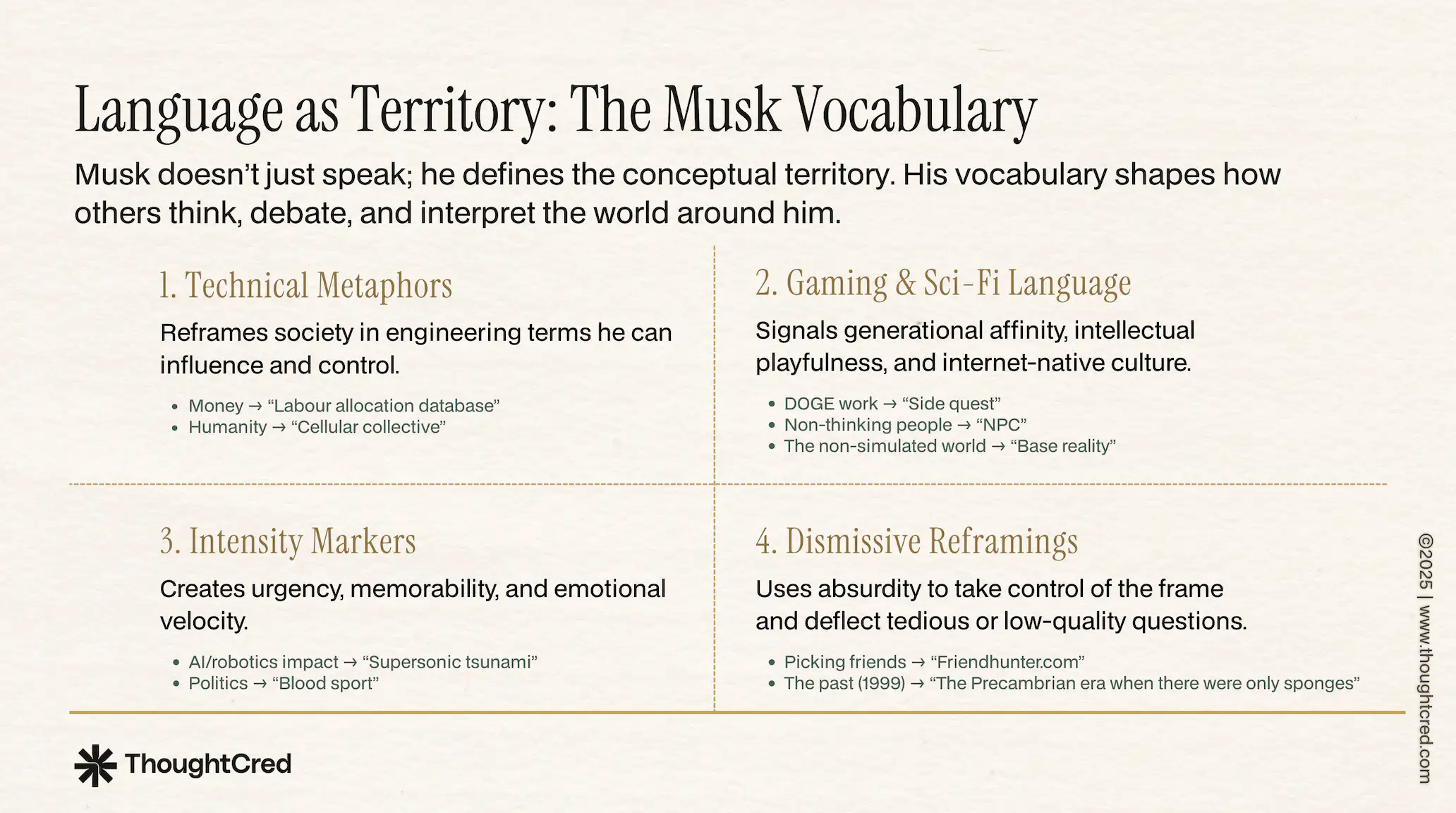
Musk has created a vocabulary that forces you to think in his frames:
Technical metaphors:
- "Cellular collective" (humanity)
- "Supersonic tsunami" (AI impact)
- "Labour allocation database" (money)
Gaming language:
- "Side quest" (DOGE)
- "NPC" (simulation characters)
- "Base reality" (non-simulated existence)
Dismissive reframes:
- "Friendhunter.com" (mocking a question about friendship)
- "Teenage Mutant Ninja Turtles" (deflecting a Michelangelo question)
When you use his words, you're thinking his thoughts.
The Stories That Stic
Musk tells the same stories repeatedly, and they do heavy work:
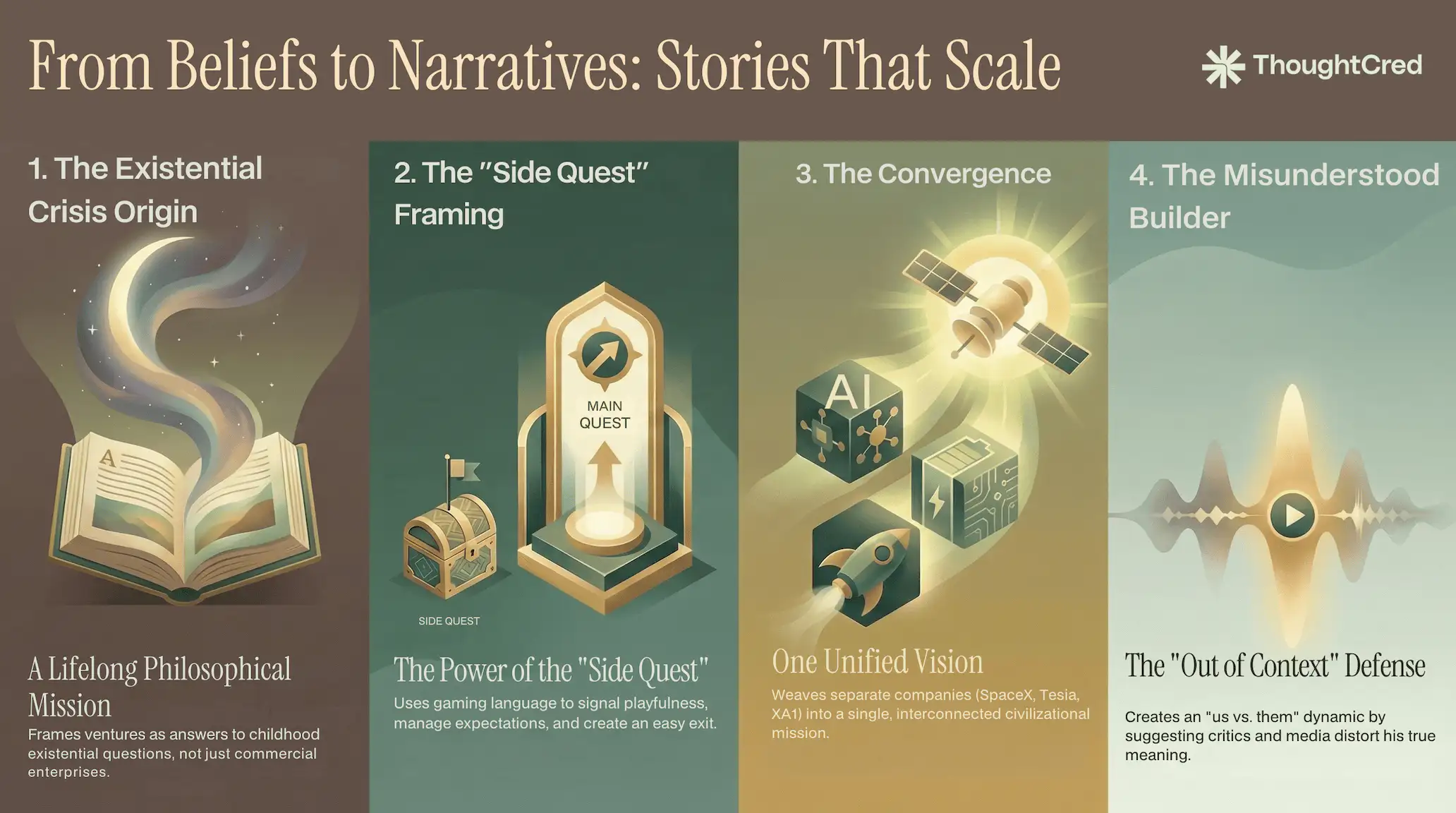
The existential crisis at 12. Every company becomes a philosophical quest, not a commercial venture.
The X.com redemption. The Twitter acquisition isn't impulsive—it's completing a 25-year mission.
The convergence. SpaceX + Tesla + xAI aren't a portfolio. They're one vision, slowly merging.
The misunderstood builder. "They take my answers out of context." (You, the viewer, are getting the real story.)
These aren't random anecdotes. They're narrative infrastructure.
What You Can Steal
You don't need to be Musk. But you can build the same architecture:
1. Derive, don't collect.Have 2-3 beliefs that generate all your positions. If your takes don't connect, you have reactions, not a worldview.
2. Reframe, don't defend.When someone asks a question on their terms, replace the terms. "That's not the right question. The real question is..."
3. Break from your tribe.Hold 2-3 positions that surprise people who think they know your politics. Contrarian takes signal independent thinking.
4. Create signature phrases."Physics-pulled." "Make more than you take." Develop 5 phrases that carry your perspective in the words themselves.
5. Tell origin stories.Connect your current work to something formative. Make it feel inevitable, not opportunistic.
6. Stay in builder mode.Every criticism bounces off "I just try to build things." Makers beat commentators. Always.
The Bottom Line
Most founders answer questions.
Elite founders replace them.
The Kamath conversation is a masterclass in frame control—90 minutes of watching someone refuse to operate inside anyone else's categories.
You're either building narrative architecture or you're renting attention.
The founder who shapes how buyers think about the category wins deals that never go to RFP.
That's the game.

Benjamin Mathew (Ben) is the co-founder of ThoughtCred and an operator who knows how to scale content without sacrificing quality. He grew SaaSindustry.com from zero to 100K monthly visitors with 2,000+ articles, led marketing for Umagine Chennai 2023 (50,000+ attendees), and built a 12-person content team at Thompson Birkman. Ben ensures ThoughtCred’s content engine stays fast, consistent, and strategically sharp.
.webp)




.svg)


