

You've spent hours creating content calendars, editorial workflows, and publishing schedules. You've documented your brand voice. You've built templates. Yet you're still scrambling to produce content, wondering why none of it seems to drive real business results.
After building content systems for dozens of AI companies—from early-stage startups to enterprise players—I've seen the same problem at every level. The difference between content systems that generate pipeline and content systems that just feel like busywork comes down to understanding what a system actually is.
What Most People Get Wrong About Content Systems
When you hear "content system," you probably think of editorial calendars, style guides, maybe a few templates. But those are just features of a system, not the system itself.
A real content system is a machine for producing results. It's made up of four components, and most companies don't even know what three of them are—let alone the fourth that makes everything work.
The three basic components are inputs, processes, and outputs.
Think of your content operation as a factory. Your input is the raw material—the ideas, insights, and expertise that fuel your content. Your process is the assembly line—how content gets created, reviewed, and published. Your output is the finished product—not just published pieces, but the business results they generate.
If you don't know what raw material you're working with, how it should be assembled, or what the end product is supposed to be, you can't run that factory efficiently.
The same applies to content. If you don't know what your inputs are, how processes flow, or what output you're measuring, how can you expect content to drive pipeline? You can't. And even if you know all three components, inconsistent inputs, inefficient processes, or unmeasured outputs mean you've built a content operation that burns your time and gives you no signal.
The Quick Win: Stop Thinking About Content Systems as Calendars
Here's a framework that changes everything.
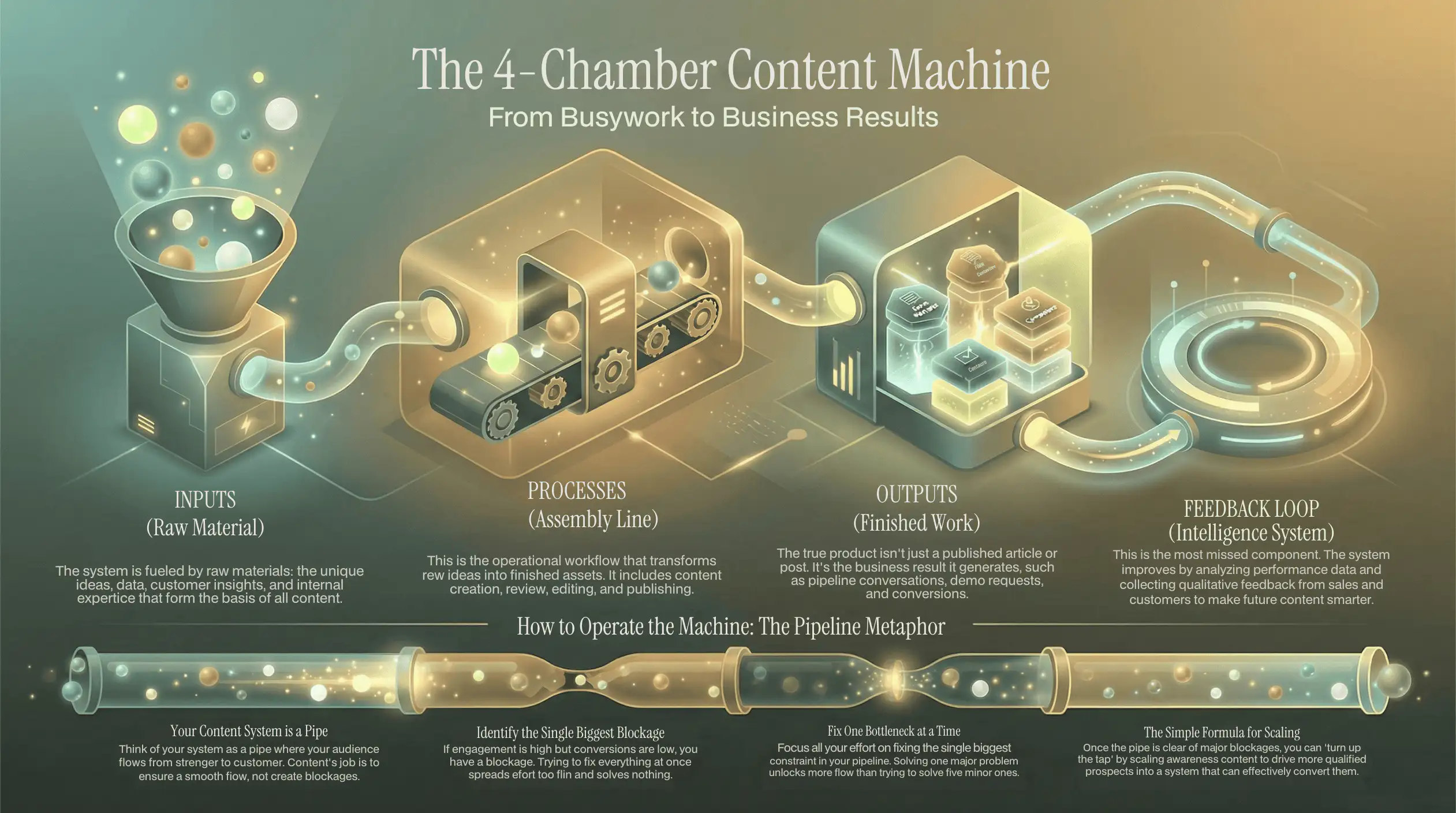
First, identify the major functions in your content operation. Every content system has ideation, creation, distribution, and measurement. Some have others, but these four are universal.
Second, identify the goal of each function. Ideation surfaces insights worth sharing. Creation turns insights into compelling content. Distribution gets content in front of the right people. Measurement tells you what's working.
Third, list every task in your content operation and write out its true goal. This is where companies get tripped up. If you're writing LinkedIn posts, you might think the goal is engagement—likes, comments, shares. But as a business, the goal of LinkedIn content is to generate conversations with potential buyers. Engagement is vanity; pipeline conversations are what matters.
Once you've done this, you'll notice every task has a goal that aligns with a function's goal. Put each task under the function with the same goal, then reorganize tasks into logical order. You can't distribute content until you've created it. You can't create compelling content until you've surfaced genuine insights. Therefore executive interviews come before writing, and writing comes before posting.
Finally, write out the steps for each task. That's your content system mapped.
Depending on your operation, this takes a few hours or a few weeks. But it's the foundation everything else builds on.
The Fourth Component Most Content Teams Miss
Even after mapping systems, most teams skip the part that actually makes content systems improve over time. This is the fourth component—the difference between a content system that drives results and one that just produces noise.
It's a feedback loop.
Without feedback, your content system becomes stale. You're stuck creating content based on assumptions instead of evidence.
I recently worked with an AI company that had what looked like a perfect content operation. They published twice a week, had clear templates, and their CEO was bought in. But none of it was generating pipeline. They thought it was a distribution problem, maybe an audience-building issue.
Turns out, their content was answering questions nobody was asking. They were writing about their technology's capabilities when buyers cared about business outcomes. They were explaining how their AI worked when prospects wanted to know how it would change their operations. The content was technically excellent but strategically useless.
We would never have found that without feedback. We interviewed their sales team about the questions prospects actually ask. We analyzed which content pieces generated the most demo requests. We surveyed customers about what content influenced their buying decision.
Then we rebuilt the content strategy around what we learned. Pipeline from content doubled in 90 days. That's the power of a feedback loop—it shows you what the content calendar can't tell you on its own.
How to Build Feedback Into Your Content System
The best feedback comes from metrics and data. This is why content scorecards matter. You need a way to track data for every piece and every channel so you're not guessing, so you can see objectively what's working and what's not.
But not everything can be tracked with a metric. So feedback loops also look like asking your sales team monthly: "What content are prospects responding to? What questions are they asking that we haven't addressed?" And asking customers: "What content did you consume during your buying process? What would have been helpful that didn't exist?"
When you're asking for feedback from people, there are issues—sales might not remember specific content, customers might not recall their journey accurately. But it's still worth doing. Having both forms of feedback is crucial. You need data to see what's working objectively, and qualitative feedback to see what's missing.
If you're not getting feedback, your content system isn't getting smarter. It's not improving. And that's exactly why it doesn't drive results.
The Pipeline Metaphor That Changes Everything
Once you have feedback, what do you do with it?
Think of a content system like a pipe. The goal is smooth flow of prospects through the pipe—from stranger to aware to engaged to customer. When content feels stuck—when you're publishing but nothing's happening, when engagement exists but pipeline doesn't, when leads come in but don't convert—it's because part of that pipe is blocked.
Your content system is a pipe with different sections: awareness content, consideration content, decision content, and retention content. The water is your audience flowing through the system. At the start of the pipe, the water is strangers who don't know you exist. As it moves through, they become aware, then engaged, then qualified, then customers.
Awareness content is the tap at the top. It controls how many people enter the system. For customers, you need qualified leads. For qualified leads, you need engaged prospects. For engaged prospects, you need awareness. The more and better your awareness content, the more you open the tap.
Here's what most content teams don't understand: if you have blockages in your pipe, turning up awareness content just puts more people into a blocked system. They still get stuck. Pipeline doesn't increase.
Say you're great at getting attention on LinkedIn—strong impressions, solid engagement. But you have no consideration content that helps engaged followers understand how your solution applies to their situation. That's a blockage. People enter the top of your funnel and then leak out because there's nowhere for them to go next.
What most teams do is try to fix all blockages at once. They launch a podcast, start a newsletter, create case studies, build a resource library—all simultaneously. But blockages typically impact each other. And if you're trying to fix everything at once, your effort is spread so thin that nothing actually gets fixed. You end up with five mediocre content initiatives instead of one excellent one.
The smart move is to fix one blockage—the main constraint limiting flow the most. Yes, this feels slower. But trying to fix everything at once feels fast until you realize you're never actually solving anything. By going all in on one constraint, you actually make progress. By going slow, you move fast.
Once you fix one blockage, fix the next, then the next. Each fix unlocks more flow, more efficiency. Fix your consideration content and more aware prospects become engaged. Fix your decision content and more engaged prospects become customers. Fix your retention content and more customers become advocates who generate referrals.
Eventually, the pipeline flows clean and fast.
The Simple Formula for Scaling Content
Scaling content is actually simple in theory. You just turn up your awareness content. Once your awareness system works and gets attention from the right people, you open the tap to drive more prospects into the system.
But you have to clear the pipe first. There's zero point in scaling awareness if the prospects will get stuck. If your content system can't convert attention into pipeline, you're just pouring water into a broken pipe.
If consideration content is your bottleneck, you lose people who could have become customers. If decision content is your bottleneck, you lose deals to competitors who better articulate their value at the moment of truth.
The formula is this: Map your content system. Track the data. Fix the bottleneck. Scale what's working. Fix the next bottleneck. Repeat.
By scaling awareness, you allow more prospects into the pipe. By fixing bottlenecks, you let more prospects flow through. Pipeline increases. Then you repeat—fixing bottlenecks and scaling distribution.
Aim for progress, for iteration. Build the system, run it, watch it break, fix it, run it again, then turn up the tap.
That's the cycle. That's how content systems actually drive business results.
At ThoughtCred, we build content systems that turn AI companies into category leaders. If your content feels like busywork that nobody reads, we can help you build something that actually generates pipeline. [Get in touch.]


Benjamin Mathew (Ben) is the co-founder of ThoughtCred and an operator who knows how to scale content without sacrificing quality. He grew SaaSindustry.com from zero to 100K monthly visitors with 2,000+ articles, led marketing for Umagine Chennai 2023 (50,000+ attendees), and built a 12-person content team at Thompson Birkman. Ben ensures ThoughtCred’s content engine stays fast, consistent, and strategically sharp.
.webp)




.svg)


